Thursday, April 29, 2021

See What's New at the Mattatuck Museum!

 Maryna Bilak's Caring Hands featured in a new segment by Eyewitness News 3, CT from Mattatuck Museum.

See What's New at the Mattatuck Museum!


Director Bob Burns speaking to Kara, Better Connecticut TV show. 


Caring Hands, 2014-2019, Caregivers' hand casting

Mattatuck Museum Collection


marynabilak.com

artist maryna bilak

художниця марина білак


Monday, March 1, 2021

Maryna Bilak's Caring Hands at Mattatuck Museum

 Maryna Bilak's Caring Hands, 2015-2019 sculpture installation currently on display at Mattatuck Museum since their grand reopening on February 28th, 2021 in Waterbury, CT.

Mattatuck Museum in Waterbury celebrates reopening by NEWS8 WTNH.com


  Caring Hands, plaster on wood, paint, purchase by Mattatuck Museum, Acquisitions Fund, 2019.7.1a-r

During the last years of her life, the artist's mother-in-law, Dorothy lived with the artist's young family. Dorothy suffered from Alzheimer's and required continuous attention. Multiple caregivers assisted the family; their participation led to this installation sculpture. Here, plaster casts of each helper represent the unseen process of tending to Dorothy and the endless cycle of care. 

Caring Hands is part of the permanent collection of Mattatuck Museum and was selected for the reopening of the museum, February 28th, 2021. 


Artist Maryna Bilak was present at the opening with her husband Maurice Haughton and her daughter Irina. 


www.marynabilak.com

@maryna_bilak

Maryna Bilak 

Марина Білак


Sunday, July 12, 2020

11 Questions for Artist Maryna Bilak by Robert Tomlinson


Photo by Susan Sabino


At what moment in your life did you realize that you were an artist? And how did that shape the important decisions you needed to make from that point forward?
The moment I realized I was an artist came long after I started to paint or draw, or make things. Only when I began questioning myself why I make what I make did I start to consider my- self an artist. From that time forward
I wanted everything to be meaningful and speak about particulars. It became harder to make things. There was more time of inaction in the studio. And there were more spontaneity and deeper questions.


Do you believe that art can be taught?
Art is in a race with its interpretation. There is no grammar in making art, but rather a plurality of rhetoric. Craft is part of art making and craft can be taught and should be taught. It is good to know and have “tools” in case you want to use them to deliver your artistic message. What is the difference between a musician and a painter? Why should a musician learn how to play a musi- cal instrument and how to read notes and spend all those hours of practice? I don’t want to take myself too seriously in the studio, but there is a desire to shoulder responsibilities for what I’m mak- ing and how I’m making it.

Can you please describe your creative process and how it has changed over the last 10 years?I started to see in layers. Whether it is painting, or drawing, or sculpture, I learned how to build in layers and how to reconstruct in layers. Every layer is very abstract, but at the same time very specific and very important and cannot be skipped. And with this discipline came an amazing freedom in my touch. I’ve developed more respect for the materials and honor the knowledge that comes with them. And it is very important for me now that the subject matter speaks to the material I choose, and vice versa.
In terms of composition I’ve become more democratic— everything counts, everything is important, each corner of the picture plane is taken into consideration.

How do you experience failure in your work and what are your coping processes?For me failure is another word for an experience. I have tried so many things. I keep trying. It is a good thing to fall, hit bottom and have the leverage to push yourself up with stronger energy. Failure brings a sense of richness. Failure brings possibilities.

As you look back on your career, if you could do it differently, what would you change?Experiment more, and work as if I will die in a couple of years.

What are you currently working on?
I am sticking with my frescoes and plaster high reliefs. But there is a desire to get rid of intention of making a “work of art.” I want to be closer to cave artists and folk artists, where people actually made things for some practical/spiritual use.
Partly I know what I want, and partly I just watch to see what will emerge in my hands and I will collaborate with it. And, simultaneously, these days being a young mother I am absorbing the experience of motherhood, feeding my imagination, getting pregnant with new ideas.

What other art forms have inspired you in your work?
A weird combination of dance, cooking and embroidery always inspired me and felt very natural. I do all of those things and see so much in common. Among many characteristics there is a gesture, there is a color and there is a discipline.

Would you give us an example or two of other artist’s works that you admire and tell us why?There are too many of them and I don’t feel like selecting just a few would be fair to the way I feel. And besides, I don’t even know names of those who made cave paintings, or most of the African and Oceanic sculptures. Those are my true heroes. Even though I experience their work visually and look at it as pure art, I know that behind each work there was a practical purpose. And perhaps that is the key to the reason I’m so drawn to them.

What is the hardest thing about being an artist?To stay honest to yourself without fear of being judged and misunderstood. Being authentic and trying to catch that change in my own growth and development is not easy. And even on an everyday basis it is hard to go to the studio and start doing something without any instructions: what, how and why are constant questions.

What is the best thing about being an artist?The best thing about being an artist is
the kind of freedom that gives you the permission to be willing to do something that may not work out. Making what
you feel passionate about and at the same time walking on edge and not staying in a safe place gives such tremendous energy. I take it as a luxury calling myself an artist.


If you were reading a review of your work, what would you want it to say?I do care about how people look at my work and what they see. I love my work to carry the dichotomy of being open and yet being mysterious. I love when viewers complete their own stories while looking at my work. I want people to relate and be engaged and to be challenged. The more comments on one piece, the better I feel about my work.

#marynabilak
#марина білак

Wednesday, January 29, 2020

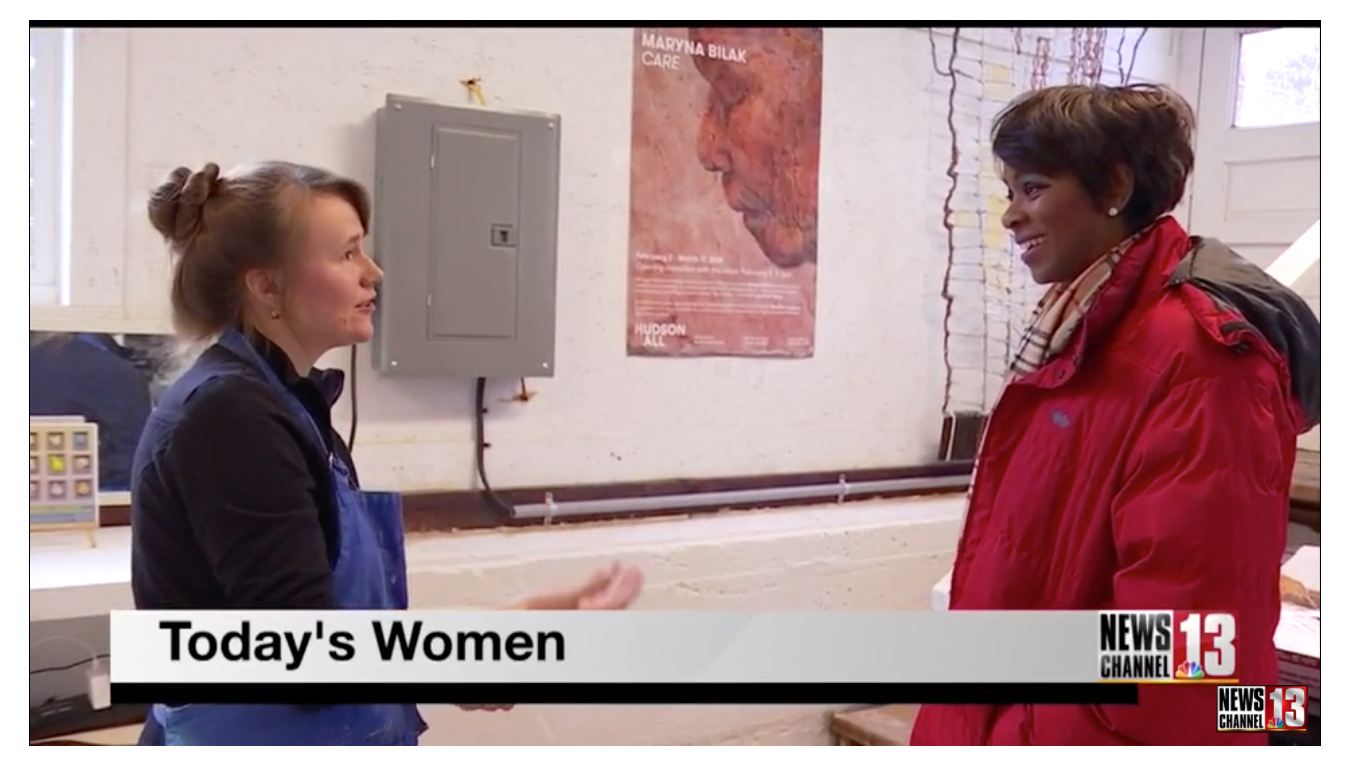
Today's Women with Elaine Houston, NewsChannel 13, WNYT

Maryna Bilak with Elaine Houston, Today's Women, News Channel 13, WNYT

CARE project
Mother-in-law's Alzheimer's diagnosis sparks art project


www.marynabilak.com
artist maryna bilak
художниця марина білак

Tuesday, September 17, 2019

CARING HANDS at Mattatuck Museum

CARING HANDS at Mattatuck Museum, September 22nd, 2019 - January 5th, 2020 


Address: 63 Prospect St, Waterbury, CT 06702

Opening reception Sunday September 22nd, 1pm-3pm
Artist talk at 2pm


Maryna Bilak's art address the process of caring for someone with Alzheimer's Disease - in this case, the artist's mother-in-law, Dorothy. Bilak explores the different roles that the act of caregiving requires from each person involved. Caring Hands is a series of 18 plaster casts the artist created from hands of those who work with Dorothy. This exhibition will take place on the second floor at Rose Hill, Mattatuck Museum.


marynabilak
marynabilak artist
mattatuckmuseum
www.marynabilak.com
художниця марина білак 


Wednesday, March 27, 2019


 Hudson-based Ukrainian artist Maryna Bilak exhibition at Hudson Hall
January 25, 2019 10:57 am


HUDSON — Hudson Hall presents Maryna Bilak: CARE, an exhibition documenting the unseen process of caring for someone with Alzheimer’s—in this case, the artist’s mother-in-law, Dorothy. Through charcoal drawings, fresco, sculpture, and painting, Bilak’s installation delves into the different roles that the act of caretaking requires from each person involved, including the patient herself.

The exhibition opens with a reception with the artist on February 2nd, 2019 from 5 to 7 p.m, featuring a performance of an original song composed for the exhibition by Memphis-based pianist Michael S. Jaynes. The piece is inspired by Jaynes’ own experience caring for his mother,also an Alzheimer’s sufferer. Molly McCann, MHA, Associate Director of Programs and Services: Diversity and Inclusion Initiatives, at the Alzheimer’s Association of Northeastern New York will also be speaking. Maryna Bilak: CARE is curated by Emily O’Leary and is on view until March 17.

Dorothy—mother, patient, older woman, mother-in-law—is the conceptual and often physical nexus for each work in CARE. In a series of traditional charcoal portraits, Dorothy is depicted chronologically, starting with softly rendered images of girlhood that evolve gradually into more harshly rendered scenes of the subject in the last vestiges of the disease. The small-scale frescos provide limited glimpses into Dorothy’s features—an eye, a mouth—and reflects on the disintegrated and fractured mental state that accompanies Alzheimer’s. The installation focuses on the tangible and intensely personal, incorporating clothing, nail clippings, hair, and plaster casts of hands and feet.

A series of cast-off hangers, clothing, including a headboard that once belonged to Dorothy turned on its side, becomes a delicate, conceptual artwork. By engaging directly with these objects, they adopt newfound significance and become an artistic language in which Bilak speaks to the experience of what it is to be a caregiver.

“This body of artwork was created as a response to the long-term care provided by my husband, Maurice and I to his mother, an Alzheimer’s sufferer,” she says. “This project is about life with a mentally and physically disabled person, and all the dedication, sacrifice and responsibility that comes with it. It is about mother, son, and artist. It is about a family,” she says.

Born in the Carpathian Mountains in West Ukraine, Maryna Bilak received her first MFA from Subcarpathian National University (Ukraine). After, she studied at Balassi Bálint Hungarian Cultural Institute in Budapest (Hungary), Charles University in Prague (Czech Republic), and in 2014 received her second MFA from New York Studio School. Since 2001 Maryna has exhibited her work in Ukraine, Hungary, Slovakia, Russia, and USA. Her recent solo show Buon Fresco/Fresh was featured at John Davis Gallery. Maryna lives in Hudson, NY, with her husband Maurice Haughton, daughter Irina and her mother-in-law Dorothy.

Sunday, February 3, 2019

The Rural We: Maryna Bilak

The Rural We: Maryna Bilak
Artist Maryna Bilak’s Winter Star sculpture has been a highlight of Hudson, New York’s Winter Walk for the past two years. Now, you can see more of her work in a new solo show, “Care,” opening at Hudson Hall on Saturday, Feb. 2. Through paintings, charcoal drawings, fresco and sculpture, Bilak documents what it means to be a caretaker for someone with Alzheimer’s and delves into the varied roles each person involved plays, including the patient herself. Born in the Carpathian Mountains in West Ukraine, Bilak studied in Budapest and Prague before receiving her second MFA from the New York Studio School. She lives in Hudson with her husband Maurice Haughton, daughter Irina and her mother-in-law Dorothy. 


I came to America in 2012 to study at the New York Studio School in Manhattan. It’s my second MFA, but the education was so different from my previous studies. It really changed me as an artist. I learned not how to make art but to ask myself why I do what I do. As I was approaching graduation, in 2014, I had a show in New York and one of the guests at the show was Maurice. He’s the reason I stayed in America. We got married and moved to Hudson, and now I have my art studio right next to the house, so I can work any time I want. Most of the art for this exhibit was made after my daughter was born; it was a very intense time. My daughter is the direct connection to my mother-in-law, who suffers from Alzheimer’s.


We moved to Hudson in 2015, but the caregiving started five years ago, when we were first dating. Most couples go through this after 20 or 30 years of marriage, but we were still in the romantic period. I became the main caregiver for Dorothy when she was still mobile, but I did all the cooking, I showered her, all these kinds of intimate things. I was working in the apartment and I would sculpt or paint on the terrace and she would watch me. When someone has Alzheimer’s, they are losing their ability to smile, but sometimes she would smile and laugh and we really had fun. I was so happy to see that she was happy. That was the beginning of our relationship.

So many people say it’s beautiful and nice to be able to care for someone like this, but it’s extremely challenging and it’s more than artwork can express. It’s something that people don’t like to talk about. There’s a level of resentment. Many people forget themselves and dedicate themselves to the person who is sick. We talked to professionals on how to deal with it, because we felt like we were disappearing.

Having Dorothy progressing with the disease put some challenges on our relationship. Very often I would go to my studio for a break; I would escape there. I tried to convince myself that it was my happy place and my rescue, but all my thoughts were still focused on the everyday experience of sharing space with someone who is mentally and physically disabled. When the denial passed, I was standing in my studio and I starting seeing some patterns in my work. I started noticing it had those connections, so I decided to embrace my situation. My mother-in-law became my model and a great inspiration. She likes the attention and I love to make art. Her features are perfect for sculpture and painting. When she was posing for portraits, she was normal, but as soon as I was finished, she would go into another world that we don’t understand.

The fact that I’m an artist, and it was the only thing I never gave up, really saved me and my marriage. The art is about Dorothy, but also about me and my husband. The part of the exhibit called “Monologues” is writing, and it’s a representation of thoughts from different perspectives. There are 12 characters and I tried to figure out how each feels. Dorothy is shown as three persons: a mother-in-law, an older lady and an Alzheimer’s s patient. Maurice is a son, a husband and a man, and I’m a daughter-in-law, a wife and an artist. It’s about how we learn how to live with each other and go through the struggles.

This is only a tiny expression of my experience, and the variety of materials speak to all the varieties of situation that come with care. “Caring Hands” is a special work because it’s a collaboration. I invited everyone who helped us with Dorothy, who provided either physical or emotional support. I mixed plaster and they each held it in their hands until it set, about eight minutes. It’s a series of hands, installed on one wall, framed but with no names, so it’s anonymous. It’s very symbolic in that it shows how many people it takes to care for someone.

Another part of the exhibit is a series of plaster abstract sculptures. Dorothy would sometimes not recognize some of her clothing and would want to get rid of it. I collected the cloth and used it as material. I sewed it together like it was a body and poured liquid plaster over it. There was very little I could do to control how it set, which is just like being a caregiver.

The exhibit shows care but also how I help myself; there were tough moments and I felt very often weak and desperate and sorry for myself, which I hate. The artwork started not on a conscious level at first, but I approached my husband about the show and he was a little apprehensive. But the artwork was happening already, and then we started learning that there are so many families having to deal with this. Three people just on our block have someone who has this disease. He’s happy now because he thinks it helps remove the stigma. I hope with my show, it can bring awareness, and people can educate themselves. If Maurice and I knew more about it at the beginning, it wouldn’t have been as hard. Hopefully people can avoid the mistakes we made. And I encourage people to have something for themselves, in my case it was art-making, because it really, really saved me.

Maryna Bilak radio interview on WGXC with Ellen Thurston and Tom DePietro

Radio interview on WGXC with Ellen Thurston and Tom DePietro. 
Section starts at 1:09:40
Discussing CARE project.

https://wavefarm.org/archive/sc594p 


maryna bilak artist
www.marynabilak.com

Maryna Bilak on Roundtable show with Joe Donahue, WAMC


 Jan 29, 2019 


Hudson Hall in Hudson, New York presents artist Maryna Bilak: CARE, an exhibition documenting the unseen process of caring for someone with Alzheimer’s — in this case, the artist’s mother-in-law, Dorothy. 
 
Maryna Bilak: CARE At Hudson Hall  


maryna bilak 

Saturday, January 26, 2019

Artist statement - CARE at Hudson Hall at the Historic Opera House, Hudson, NY


Opening reception on Saturday, Feb. 2, from 5 to 7 p.m., featuring a 6:30 p.m performance by pianist Michael S. Jaynes. 
The exhibition runs through Sunday, March 17
Hudson Hall, 327 Warren St., Hudson.

Artist statement  
Maryna Bilak


CARE

The reality of caring for someone with advanced Alzheimer's is more insane than any work of fiction. I tried to convince myself that my studio was my “happy place” and that art-making was my rescue. But my thoughts all focused on the everyday experience of sharing an intimate space with someone who is physically and mentally disabled. When the energy of denial exhausted itself, I decided to embrace my reality and consciously navigate and dedicate my creativity. Suddenly everything made sense. I stared and began to see patterns in my artwork from the last five years—the time I have lived with my mother-in-law. She became my model, and the body I watched and touched so many times became an inspiration for the active studio process.

The work I have done for this project is only a tiny expression of my experience which is as complex as it is difficult to define. The verities of the materials speak to the endless cycle of care. Using different media allowed me to work through different emotions. Clay, plaster, charcoal, acrylic, wood, cloth, nails, lime, pigments among others learned to coexist.

There are no words and there are no colors to represent the tragedy of Alzheimer’s disease and the impact it has on people providing care. But no matter what the subject is, for an artist, good form comes first. Without a good form there is no content.

This show is a resolution: to decline to be a hero and refuse to be a victim. Every piece contributed to my process of releasing strong, repressed emotions as a caregiver, as a daughter-in-law and as a wife. Preparation for this show provided relief and served as catharsis of all the struggle and frustration.


Sunday, January 20, 2019

Maryna Bialk and Molly McCann on The Roundtable Show at WAMC

https://www.wamc.org/programs/roundtable


January 29th at 10.30am artist Maryna Bilak will be interviewed by Joe Donohue on WAMC’S “The Roundtable” show. This show hosted Madeleine Albright, Jimmy Carter, John McCain, Bob Dole, Steve Martin, Arthur Miller, Kurt Vonnegut, Maya Angelou, Stephen King, Melissa Etheridge among other A-list newsmakers, authors, artists, sports figures, actors, and people with interesting stories to tell.


Tune in on January 29th at 10:30am and listen to Maryna and Molly McCann, Alzheimer’s Association of Northeast NY Associate Director, discussing Maryna’s upcoming show CARE at Hudson Hall at the Historic Hudson Opera House, which opens on February 2nd. Show curated by Emily O'Leary.


WAMC's The Roundtable is an award-winning, nationally recognized eclectic talk program. The show airs from 9 a.m. to noon each weekday and features news, interviews, in-depth discussion, music, and much (much) more! Hosted by Joe Donahue and produced by Sarah LaDuke, The Roundtable tackles serious and lighthearted subjects, looking to explore the many facets of the human condition with civility, respect and responsibility.

www.marynabilak.com
maryna bilak artist
марина білак

Maryna Bilak at Hudson Hall at the Historic Hudson Opera House, NY

ps://hudsonhall.org/2016/12/17/maryna-bilak-care

EXHIBITION ON VIEW FEBRUARY 2 – MARCH 17, 2019

Hudson, New York 

OPENING RECEPTION WITH THE ARTIST: Saturday, February 2, 5 – 7pm

Through charcoal drawings, fresco, sculpture, and painting, artist Maryna Bilak documents what it means to be a caretaker for someone with Alzheimer’s and delves into the varied roles each person involved plays, including the patient herself. The exhibition is curated by Emily O’Leary.
At the opening reception, Tennessee-based pianist and composer Michael S. Jaynes will perform Curvature of the Mind, a piece inspired by his experience caring for his own mother, an Alzheimer’s
 sufferer.


ABOUT THE ARTIST
Born in the Carpathian Mountains in West Ukraine, Maryna Bilak received her first MFA from Subcarpathian National University (Ukraine).  After, she studied at Balassi Bálint Hungarian Cultural Institute in Budapest (Hungary), Charles University in Prague (Czech Republic), and in 2014 received her second MFA from New York Studio School. Since 2001 Maryna has exhibited her work in Ukraine,Hungary, Slovakia, Russia, and USA. Her recent solo show Buon Fresco/Fresh was featured at John Davis Gallery. Maryna lives in Hudson, NY, with her husband Maurice Haughton, daughter Irina and her mother-in-law Dorothy. 

марина білак
maryna bilak
www.marynabilak.com 

Tuesday, January 15, 2019

Maryna Bilak - CARE

MARYNA BILAK
Solo show - CARE

Hudson Hall at the Historic Opera House
February 2nd - March 17th
Reception with the artist February 2nd, 5-7pm


An exhibition documenting the unseen process of caring for someone with Alzheimer’s—in this case, the artist’s mother-in-law, Dorothy. Through charcoal drawings, fresco, sculpture, and painting, Bilak’s installation delves into the different roles that the act of caretaking requires from each person involved, including the patient herself. The exhibition opens with a reception with the artist on February 2nd, 2019 from 5 to 7pm, featuring a performance of an original song composed for the exhibition by Memphis-based pianist Michael S. Jaynes. The piece is inspired by Jaynes’ own experience caring for his mother, also an Alzheimer’s sufferer.  
Molly McCann, MHA, Associate Director of Programs and Services: Diversity and Inclusion Initiatives, at the Alzheimer's Association of Northeastern New York will also be speaking.
Show is curated by Emily O'Leary. 


www.marynabilak.com
artist maryna bilak
марина білак

Tuesday, August 14, 2018

Special Gallery Tour for Special Ladies - Perfect Ten at John Davis Gallery

Perfect Ten - an organization which empowers girls to become strong, secure, independent and confident women.
https://perfecttenhudson.org/

It was a special visit of Perfect Ten at John Davis Gallery to see Buon Fresco/Fresh art show.

http://johndavisgallery.com/maryna-bilak/


Maryna Bilak artist
#marynabilak
www.marynabilak.com
Марина Білак

Monday, August 13, 2018

Opening Night - Gallery Visits at John Davis Gallery, Hudson, New York

 Buon Fresco/Fresh art show at John Davis Gallery
Maryna Bilak's first solo show in Hudson, New York

Maryna Bilak with Emily O'Leary


Maryna Bilak with Ron Milewicz


Maryna Bialk with Leonard Behr


Maryna Bilak with Jock Ireland


Maryna Bilak with Fukuko Harris   


Maryna Bilak with her husband Maurice Haughton


Maurice Haughton, Dianne and Ron Somma  


Maryna Bilak with Vasta 

 
Adrianne Lobel


Maryna Bilak with Karen Ensanian


Maryna Bilak artist
#marynabilak
www.marynabilak.com
Марина Білак